Judging Terror
This research project critically engages with terrorism trials in Germany involving far-right and jihadist ideologies. In line with a critical legal studies approach that denies law and judicial practice’s claims to be nonpolitical, our critical analysis focuses on law in action and its connections with political decisions. It thus acknowledges academic debates on a securitization of criminal law that shifts jurisdiction to pre-trial investigation, criminalizes pre-crime behaviour and ultimately impacts court proceedings, potentially compounding intersectional discrimination. We ask how the negotiation of ‘terrorism’ in the interactions and performances of engaged actors in court (micro level) interconnects with the (re)production of judicial knowledge of terrorism in court and public knowledge of it in the media (meso level) in order to draw conclusions regarding the negotiation of terrorism in society more generally (macro level). Our aim is to understand how social dynamics unfold in trial proceedings and impact the negotiation and production of terrorism as a criminal legal and epistemic object. While we focus on German courts, we understand terrorism trials as a multi-sited field substantially shaped by globalized communication and international mobility and security practices.
Project duration: 01.01.2025 - 31.12.2027
Project partners: Dr. Nicole Bögelein, University of Cologne; Dr. Kerstin Eppert & Viktoria Roth, Bielefeld University & Dr. Anja Schmidt-Kleinert, Philipps-Universität Marburg
Publications
- Bögelein N./Eppert K./Roth V./Schmidt-Kleinert, A. (2022a). Courtroom Ethnography in the Context of Terrorism: A Multi-Level Approach. International Journal of Qualitative Methods. January 2022. doi:10.1177/16094069221090059
- Bögelein, N./Eppert, K./Schmidt-Kleinert, A (2022b). Conference proceedings of the international symposium “Terrorism in Court – National Courts as Empirical and Epistemic Field in Terrorism and Violence Research”. Kriminologie - Das Online-Journal | Criminology – The Online Journal, 4(4), pp. 452-458
Presentations
- "Identitätsverhandlungen vor Gericht – Zur (Re)Konstruktion des terroristischen Subjektes", Session 11: Track 1: Vor Gericht, 5. Kongress der deutschsprachigen Rechtssoziologie-Vereinigungen, Innsbruck, 23.09.2023 (Dr. Kerstin Eppert & Dr. Nicole Bögelein)
Project Team Cologne
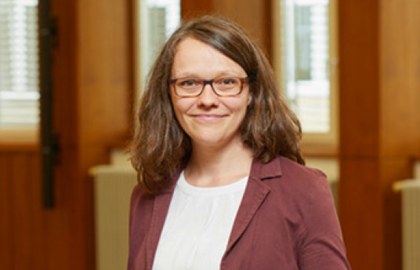
PD Dr. phil. Nicole Bögelein, Dipl.-Soz.
Tel.: 0221 / 470-4357
Nicole.Boegelein uni-koeln.de